Artemis II: History of Braids and how they connect people through time and space
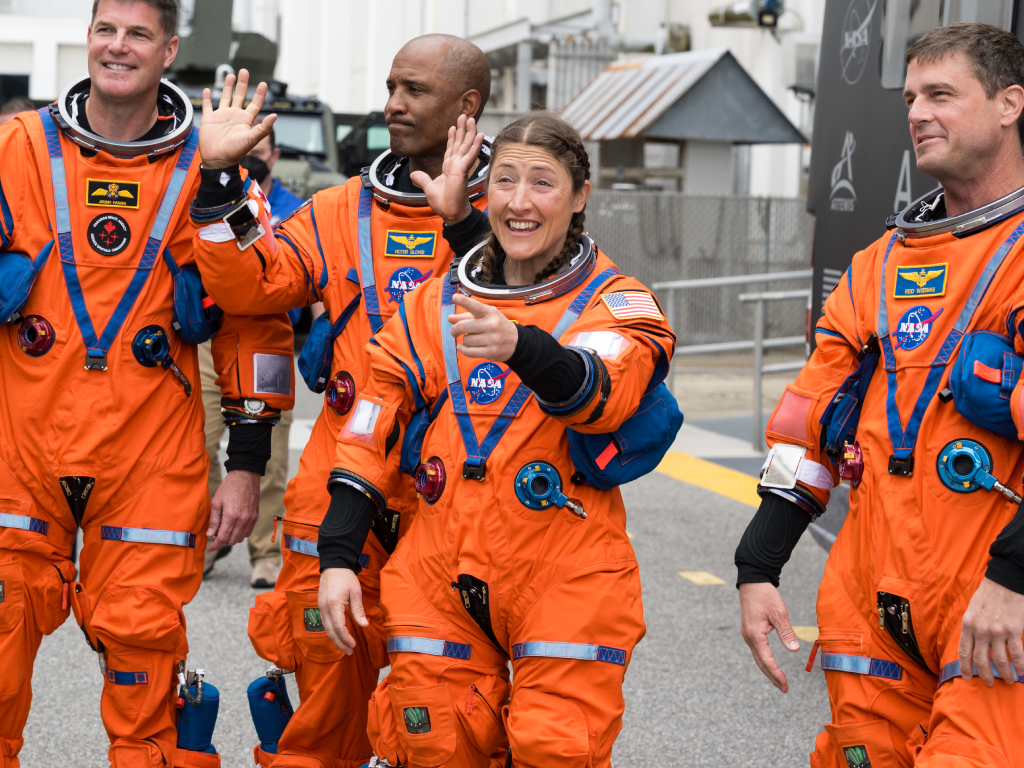
With everything going on, on Earth, it can be hard to conceptualize just how little of space we’ve yet to explore. When mission specialist Christina Koch boarded the Orion spacecraft ahead of the Artemis II mission, she wove a bit of our planet’s history into her hair.
Koch’s choice to wear “boxer braids” before lift-off Earth has a constellation of origins. This colloquial name for the braids is often a reference to the style’s popularity amongst boxers – athletes who need a practical way to keep their hair out of their face. While undeniably utilitarian, they’re still an expression of style and solidarity within a male dominated field (not dissimilar to Koch’s trajectory).
The history of this hairdo goes far beyond women’s sports and space travel, as the practice has deeper ancestral roots. “Boxer braids” are an evolution of the “Cornrow” – a decorative and protective hair style named after the rows of corn fields where slaves in the Americas worked. The style was reclaimed around the 60s, when revolution was ripe and resilient. Black women rejected Eurocentric beauty standards which favored straight hair, allowing them to embrace their natural texture and protective styles. Overtime, these women would pioneer new and elaborate braiding styles, adding an empowering twist to their roots.
Roots that, when braided correctly, could even relay important messages during the 16th century Colonial era. Afro-Colombian hairbraider, Asprilla Garcia, recounted the oral history of braids being used to spread messages between slaves in her 2011 interview with the Washington Post. As many slave owners had learned their native languages, communicating through codes in hairstyles offered them an outlet to communicate freely. Between styles called departes that would signal their desire to escape ( ‘you leave’ in Spanish), and curved braids stuffed with gold and seeds to “represent the roads they would [use to] escape.” Hair braiding was a secret weapon in their fight for freedom.
It was a tradition carried over from tribal groups in Africa, as several cultures across the continent forged strong spiritual connections and communal bonds through hair. Grooming rituals could last from hours to days, acting as an opportunity to pass the practice across generations. The patterns, materials, and meaning behind their braids varied from tribe to tribe. Alysa Pace, a hairstylist in Beverly Hills, credited the origin of the braid in her interview with Byrdie to the Himba people of Namibia. “In many African tribes, braided hairstyles were a unique way to identify each tribe. Braid patterns and hairstyles were an indication of a person’s tribe, age, marital status, wealth, power, and religion." For example, Hima women were only allowed to wear two braids as girls, but earned the right to more after marriage – her husband was only allowed one.
Across the rest of the world, numerous other cultures found a way to make the plait their own. Indigenous Americans wore “pigtail braids” in the 400s, Chinese people braided their hair in a staircase shape from 1644 all the way until 1912, and the European “crown braid” worn from 1066 to 1485 all still speak to our current hair braiding traditions. The ancient Celts braided their hair as well, incorporating beads, ribbons, ornate hair pins, and precious metals depending on their class. Women were described as having their hair “knotted”, an anecdote that could have inspired the Celtic Knot hairstyle. The Irish epic poem, Táin Bó Cúlaigne, also has a depiction of a woman wearing three braids wrapped around her head, with a fourth reaching all the way down to her ankles. No matter where in the world you are, and no matter where you come from, the braid manages to twist itself into our lives from every direction.
Toch’s choice of braids may seem like just a casual, protective hairstyle, but she might have brought a bit of ancient magic along with her for the ride. The ancient Egyptians believed braiding their hair protected them from evil and brought good luck – exactly the kind of energy one would want to channel taking off for a historic trip to space. Although the astronaut eventually let her hair down (as much as possible in zero-gravity), the photos of her boarding evoked the truest senses of resilience, heritage, and progress. She wasn’t alone either, as her crewmate Victor Glover made history as the first Black man to travel to deep space.
While Glover doesn’t have much hair to braid himself, his daughters rock their natural hair with pride – a heart-warming tribute post to Instagram also included adorable throwback pics, with two of the girls wearing braids. The history and culture of hair is everywhere, and yet it’s ultimately contained in one moment among trillions, in our personal corner of the universe. Glover’s reflection on the Artemis II mission in an interview with CBS was especially touching, as he looked back at the Earth with a higher perspective.
Glover explained how “I think maybe the distance we are from you makes you think what we’re doing is special, but we’re the same distance from you. And I’m trying to tell you … you are special. In all of this emptiness — this is a whole bunch of nothing, this thing we call the universe — you have this oasis, this beautiful place that we get to exist (in) together. I think as we go into Easter Sunday thinking about all the cultures all around the world … this is an opportunity for us to remember where we are, who we are, and that we are the same thing. And that we got to get through this together."
While braids come from all over the world, our ability to share, grow, and innovate together is truly what links us all together.
Written by: Alia Ayoubi @aliairis
Edited by: Alex Kelleher @alex_kelleher_
