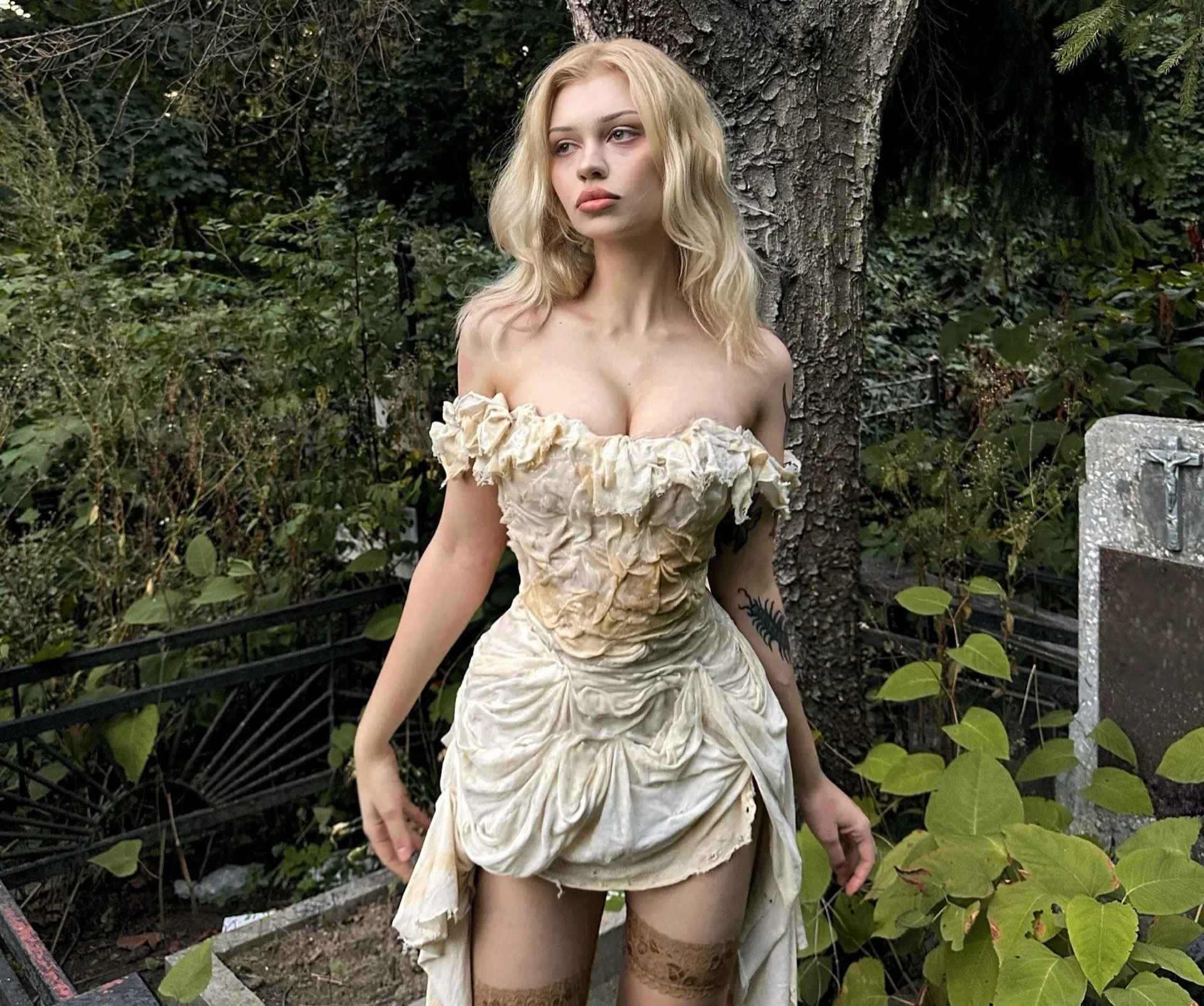
Rust is a strange thing to put on a dress. It is what happens to metal when nobody is looking after it, and Kate Brilliant sewed it into a garment next to silicone, which does the opposite job: it is smooth, synthetic and uncomfortably close to skin. Put the two together and you get a dress that seems to be ageing and healing at once.
Tension is her method.
Brilliant is a Kyiv designer who makes clothes about the parts of people they would rather keep out of sight. She works with deconstructed shapes, experimental materials and handmade details, and she likes things that look a little raw or unfinished. Her collection for, I DREAM ABOUT YOU was made in three weeks, almost entirely alone, with every piece sewn by hand. Shown inside an installation with an original soundtrack and fragrances made for the project, taking the audience from fear, through anxiety and into melancholy.
That is a more serious ambition than most runway shows have. Starfish sat down with Kate to talk about the dress she cried over, the missile that landed ten minutes from her venue, and the corset she is saving for later.
Where did I DREAM ABOUT YOU start?
In January, when I met Nastia Fertenko. We both wanted to make something together, an avant-garde fashion experience that went beyond the traditional format of a fashion show.
Kyiv was living under constant missile attacks at the time, and continuing to create felt both difficult and necessary. We didn’t want to ignore the reality around us, but we didn’t want it to take away our ability to dream, imagine and make things.
For me, the title is about freedom: the freedom to become someone beyond the version of yourself that circumstances or other people have imposed on you. A dream can be a way of reconnecting with your desires, even when reality feels overwhelming.
Is there one piece in the collection that is especially personal?
The dress with the rust and silicone elements. When I first started sewing it, I cried for a couple of hours. That summer, the war had taken away my sense of being a creator. I felt cut off from the part of myself that wanted to make things, experiment and express something through clothing.
Working on that dress helped me find my way back. It reminded me why I create in the first place.
The materials mattered too. Rust carries associations with time, decay and transformation, while silicone brings in something artificial and almost skin-like. I was drawn to the tension between them.
Body, materials, identity: those ideas run through all your work. How did they develop here?
I’m interested in the parts of ourselves that we tend to hide, the things we suppress, fear, or don’t know how to express. Clothing can be a kind of second skin. It covers the body, but it can also reveal an inner state.
For this collection I wanted to explore vulnerability and strength, attraction and discomfort, control and surrender. I’m interested in the shadow side of a person: the desires, fears, contradictions and fantasies that don’t fit the image we present to the world.
I often work with deconstructed forms, experimental materials and handmade details, because I’m drawn to things that feel imperfect, raw or slightly unfamiliar. I don’t want clothing to dictate how someone should look or feel. I’d rather make pieces that let people discover something about themselves.
Was there anything you had to leave out?
A corset grown from mycelium, developed with a biolab and Alisa Khvylia. I didn’t have the time or the energy to finish it before the show, so I decided to leave it for later rather than force it into the collection before it was ready.
I’m still interested in this material and in the relationship between fashion, living systems and the human body. It’s an ongoing experiment, not an abandoned one.
You shared the project with Anastasya Fertenko and Kimera. How did the three of you divide it up, and what went wrong?
We each brought a different perspective, and I think that contrast was essential. I was responsible for the art direction of the event, and Nastia led the creative direction. Her work explores freedom as an internal state and a process of transformation: how identity can change, and how the body can be revealed, concealed or reshaped through silhouettes. My own practice is more about the hidden sides of a person and how clothing can give our inner world a physical form. Kimera created the entire beauty direction, which completed the visual language of the project.
The process was intense. I made the collection in three weeks, almost entirely on my own, sewing every piece by hand.
The hardest moment came about thirty minutes before the show, when a ballistic missile struck roughly ten minutes from the venue. The police wanted to cancel. Many people had already arrived, and we didn’t want to lose the chance to bring the project to life. We had to make decisions under enormous pressure.
It made the project feel even more tied to its central idea. We were trying to make a space for freedom, dreams and self-expression while the reality of war was right there. It was a reminder of how fragile these moments are, and how much they matter.
How did you build the atmosphere?
Music was crucial. My friend Alisa Haspid composed an original soundtrack for the show. She came to visit, and we spent time talking through the project and imagining the emotional journey we wanted the audience to take.
I wanted it to begin with fear and anxiety, then move gradually towards melancholy, leaving people with a certain emotional aftertaste. I had no interest in making something that simply looked beautiful on a runway. I wanted the audience to feel they had entered a particular state of mind.
Sound, light, movement, fragrance and the spatial installation all worked together. We made the fragrances with POPIDTYNOM, developed specially for the project. Scent is less direct than an image, but it is deeply connected to memory and emotion.
All of these were different languages telling the same story. The clothes weren’t meant to exist separately from their surroundings. They were part of a larger emotional landscape.
What do you want people to remember afterwards?
That it was something they experienced rather than something they watched. We wanted to move beyond the traditional fashion show and build an environment where clothing, music, light, movement, fragrance and space became one experience, with the audience inside it.
The project explores the versions of ourselves we hide, the desires we don’t always allow ourselves to acknowledge, and the distance between who we are and who we feel we should be. I’m interested in what happens when we start to move from fear towards desire, from concealment towards revelation, and from other people’s expectations towards our own voice.
I don’t expect everyone to read it the same way. I’d rather people leave with different feelings, questions or associations, perhaps recognising something in themselves they hadn’t thought about before.
I DREAM ABOUT YOU is about giving ourselves permission to exist beyond a fixed image of who we are supposed to be. For me, that is one of the most important things fashion and art can offer. Fashion and art can’t give us answers, but they can make it possible to see ourselves differently.
Written By: Pranamya Shetty
Edited By: Hazel Hunter
