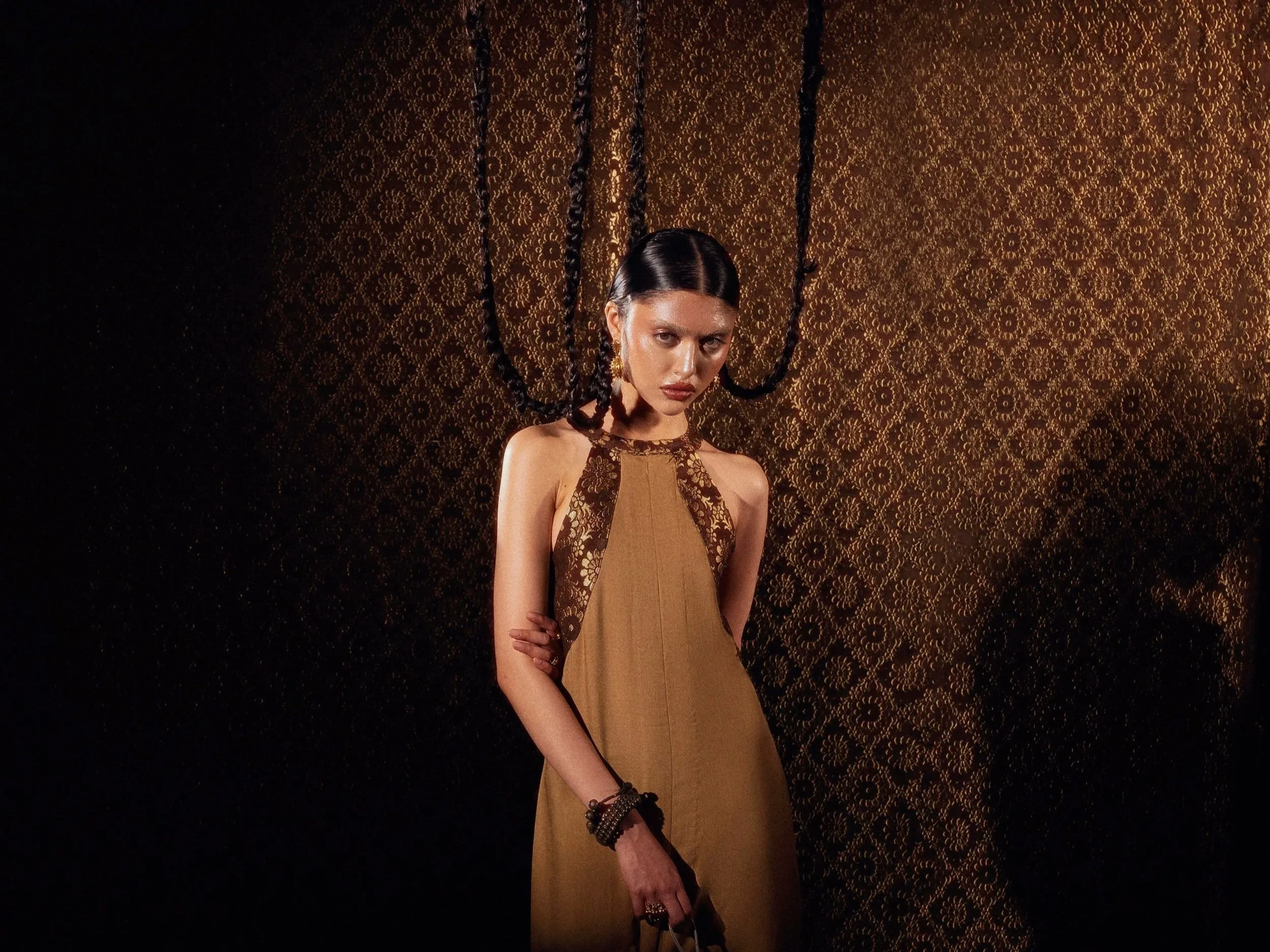
Fashion loves the image of a powerful woman.
Every season, there she is: standing tall, taking up space, draped in the language of liberation. She is visible, celebrated, empowered. At least, that's what we're told. But what if visibility isn't the same as freedom? What if some of the structures designed to control women never truly disappeared, only learned how to look more appealing?
This unsettling question sits at the heart of Re/form, the Spring/Summer 2026 editorial from Lahore-based label Collected XX. Inspired by legendary Pakistani feminist poet Kishwar Naheed's poem Ye Hum Gunahgar Aurten Hain (It Is We Sinful Women), the project interrogates one of society's oldest habits: the persistent tendency to position women as both the source of disorder and the people responsible for fixing it.
Across religions, cultures, and centuries, women have repeatedly been handed the burden of blame. Eve's decision in Eden becomes Original Sin. Sita must walk through fire to prove her purity. Even in narratives where divine texts place men and women on equal footing, cultural interpretations have often found ways to redirect responsibility back toward women. The details shift according to geography and belief system, but the pattern remains remarkably familiar. The woman is questioned, tested and is expected to prove herself.
Kishwar Naheed confronted this reality more than three decades ago when she wrote Ye Hum Gunahgar Aurten Hain, a poem that challenged the inherited guilt forced upon generations of women. Rather than rejecting the accusation, Naheed famously embraced it with biting irony. Fine, the poem seems to say. If refusing obedience makes us sinful women, then sinful women we shall be.
That spirit of resistance runs through every frame of Re/form.
The editorial unfolds not as a fashion campaign but as a visual argument. Through carefully constructed tableaux, women become symbols of the expectations placed upon them, trapped inside structures disguised as opportunities, celebrations, and traditions.
One of the campaign's most striking images places a woman's head at the centre of a dining table, surrounded by pristine steel plates and serving bowls. It is an uncomfortable image because its metaphor is impossible to ignore. She is no longer simply sitting at the table; she has become part of it. A centerpiece. An offering. Something to be consumed.
The image speaks to a familiar contradiction. Women today are often told they are more visible than ever, yet visibility alone does not guarantee autonomy. In the photograph, she commands attention while simultaneously possessing no power over her situation. She is presented as important while remaining entirely immobilized. It is empowerment as performance.
Elsewhere, women are elevated only to reveal the fragility of the platform beneath them. In one scene, a figure stands atop a narrow circular structure beneath artificial rain, carrying a celestial rod adorned with stars. At first glance, it resembles triumph. Look closer, however, and it begins to feel more like an elaborate balancing act. The pedestal offers no room to move, no opportunity to stumble, no space to exist imperfectly. Fall from it and the illusion disappears.
It is perhaps the campaign's sharpest observation about modern womanhood: being elevated is not always the same thing as being liberated.
Nowhere is this critique more effective than in the editorial's recurring use of South Asian cultural symbols.
The traditional pattie, a trunk historically associated with a bride's dowry, reappears not as an object but as a prison. Lined with lush floral velvet and constructed with sculptural precision, it initially reads as luxurious. Beautiful, even. Yet folded inside it is a woman whose body appears swallowed by its structure.
It is difficult to imagine a more effective metaphor for contemporary patriarchy. The box has become prettier, the confinement remains. That image lingers because it reflects a reality many women recognize. Modern systems of inequality rarely announce themselves openly. They do not always arrive dressed as restriction. More often, they present themselves as protection, celebration, aspiration, or opportunity. They tell women they are valued while quietly defining the terms of that value. Throughout Re/form, this idea repeats itself in different forms. Women appear packaged, displayed, confined, examined, and suspended. In one image, a model is transformed into a living marionette, her braids becoming puppet strings connected to a wooden frame. In another, a towering stack of ceremonial red cushions becomes a monument to inherited obligation, elevating a woman high above the ground while a man remains comfortably seated below, untouched by the same expectations. The symbols are theatrical, but the underlying critique is painfully familiar.
What makes the editorial particularly successful is that it refuses to offer easy answers. It does not suggest that feminism has failed, nor does it deny the very real process women have fought to achieve. Instead, it asks a more uncomfortable question: how do we recognize oppression when it adapts to the language of progress? Because power rarely survives by remaining unchanged, it survives by evolving.
The most compelling aspect of Re/form is its insistence that liberation should be measured by more than visibility, representation or symbolic victories. Those things matter, but they become insufficient if the underlying structures remain intact. A gilded cage is still a cage. A velvet lined prison is still a prison.
By drawing together religion, mythology, feminist literature and South Asian cultural traditions, Collected XX has created something that extends far beyond fashion imagery. Re/form functions as a mirror, forcing viewers to question which expectations have genuinely disappeared and which have simply become harder to see. In an era that is constantly congratulating itself for progress, that may be the most radical question of all.
Written By: Valerin Vanegas
Edited By: Rose Curnyn
