Reclaiming the timeless tramp-stamp
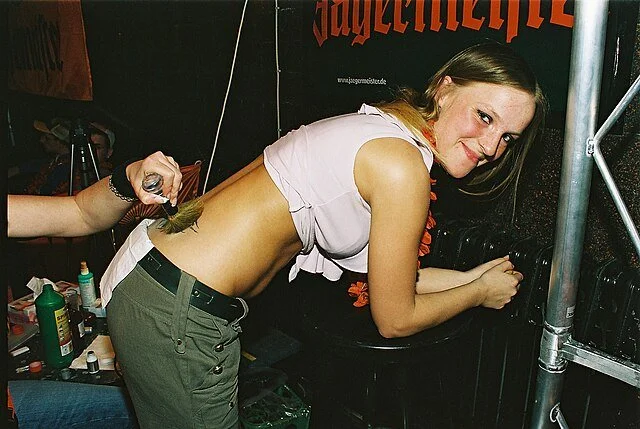
Now that the 90s are back, so is that cheeky ink we are lucky to catch a glimpse of when someone sits or bends down. Yes, get designing, because tramp stamps are back (the lower back wink wink). But while today we proudly celebrate more of these tattoos as a sign of femininity, in the past, it has had a negative reputation.
While the 90s made this tattoo placement a social cue, it actually has divine and ancient origins. Can you imagine Cleopatra rocking a tramp stamp? We’re with you, Mark Antony, because we wouldn’t be able to resist either. Ancient Egyptians are the ones who gave this tattoo a life of divinity and fertility. While this became cultural roughly 1,000 years before Cleopatra was born, many mummified remains were used for ‘sympathetic magic’. Used to protect women during childbirth, these tattoos would often be dedicated to the ancient Egyptian god Bes.
So how did these divine symbols fall into public criticism and become the new ‘scarlet letter’?
Well, it wasn’t always referred to as the ‘tramp stamp’ in the 90’s. As women became more and more self-expressive and tattoos became more popular outside of biker-gangs, women adopted the tramp-stamp as a way to rebel against societal oppression and become more self-empowered. With women’s expectations relying heavily on their appearances, the idea of the ‘perfect’ girl suffocated any individuality or expression these women possessed.
Until, the tramp stamp became a way for these women to take back their bodily autonomy. Having the tattoo positioned on the lower back made it practical. It was able to be easily hidden, but at the same time accessible if a woman wanted to show it off. And more people seemed to be making that decision during the 90’s era ‘cool girl’.
Where icons like Gwen Stefani and Shirley Manson were bringing the ‘alternative’ girl into the conversation. These women rocked the rebel and artistic persona that is still celebrated to this day. What was so alluring about this aesthetic? It was the perfect mixture of sexy yet feminine that evoked curiosity and a sweet danger.
And nothing paired better with the tramp-stamp than a classic low-rise (I mean low) jean, the perfect frame for the art that rested on the tailbone. And we went from 0-100 in the mid 90’s, when women went from hiding their tattoos to waving them at us with each step. And we have Alexander McQueen’s ‘bumster’ pants to thank for that, along with the crop tops they were paired with. And throughout the mid-to-late 90s, this was socially seen as sexy. With the right angle and movement, it was a sign of flirtation and sexual empowerment of women. Both men and women regarded this symbol as generally ‘high fashion’, a new social cue that was confident and artistic.
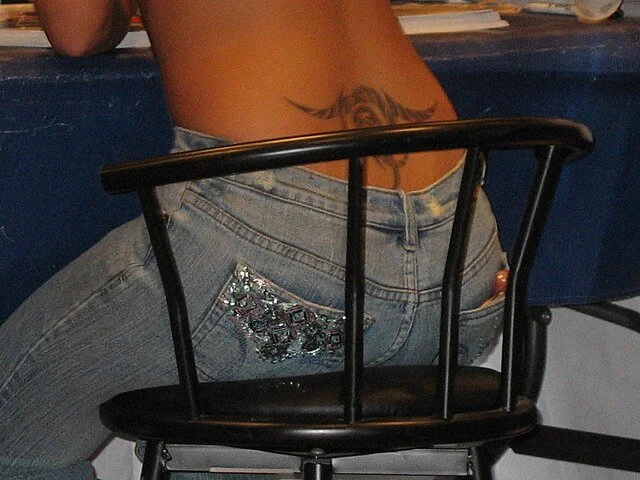
And celebrities like Gwen Stefani were shameless about rocking low-rise jeans that you didn’t think could go any lower. She became an iconic patron of the tattoo, often posing for the cameras in intentionally low-cut dresses that put her identity in alignment with the female-empowerment that was the tramp-stamp.
So how did we go from paparazzi flashes on the tramp-stamp to ads for tattoo removal?
Well, the criticism began when people started to culturally appropriate tribal art. While learning the history and celebrating another culture in an educational manner is admirable, using symbolic art as simply ‘decorative’ is not. And these western tattoo trends began to use symbols from Polynesian, Maori, and Celtic cultures, disregarding the symbolic meanings they carry.
And as the 2004 SNL skit on lower back tattoo removal made a mockery of the tramp-stamp, it was aimed at carrying these tattoos forever. The skit covers the scene of a mother with her kids, and essentially focuses on the maternal image that women are expected to uphold. As if their ‘wild’ side was only acceptable during a window of their 20s. Most of the tramp stamps shown in the skit were degrading, with words like ‘juicy’ and ‘pretty lady’, giving the impression that these tattoos were centred around the male gaze rather than female empowerment.
And unfortunately, while this phrase is still heard today, the whole ‘you’ll regret it when you're older’, is the main ‘argument’ for this skit. Where it shows a woman ageing and mocks her beauty disappearing with that time, and along with it her ‘acceptability’ to be expressive.
Hollywood ran with it, beginning to weaponise the tramp-stamp. With films like Wedding Crashers (2005) referring to the tattoo as a ‘bullseye’, taking the whole idea of female empowerment and turning it into a sexual invitation. Celebrities like Britney Spears were used as a way to associate the tattoo with ‘party-girls’, often signalling women with these tattoos were ‘easy’ and ‘lacked respectability’.
And as Gen Z is so admirably known for, is their curated irony. This generation is notable for taking shameful things of the past and rebranding them as powerful. And the tramp-stamp is no different. From more modern-designs (that are also culturally-appropriate), they have redefined the tramp-stamp to its former glory. With floral and dainty designs to more sharp-thorned designs, this generation is not limiting themselves when it comes to designs allowed as a lower-back tattoo.
Gen-Z has used a symbol that was once used to encourage male-dictation on what is feminine and ‘young and cool’, as the male doctor in the SNL skit put it, and almost took the power away from the tattoo and gave it to the women. Signalling that what is on our bodies is not what determines our value or makes us feminine, it is something that can’t be taken away or given, it is us - with or without our historic and iconic tramp-stamps.
Written By: Sophia Arceo, @sophiearceo
Edited By: Alex Kelleher @alex_kelleher_
