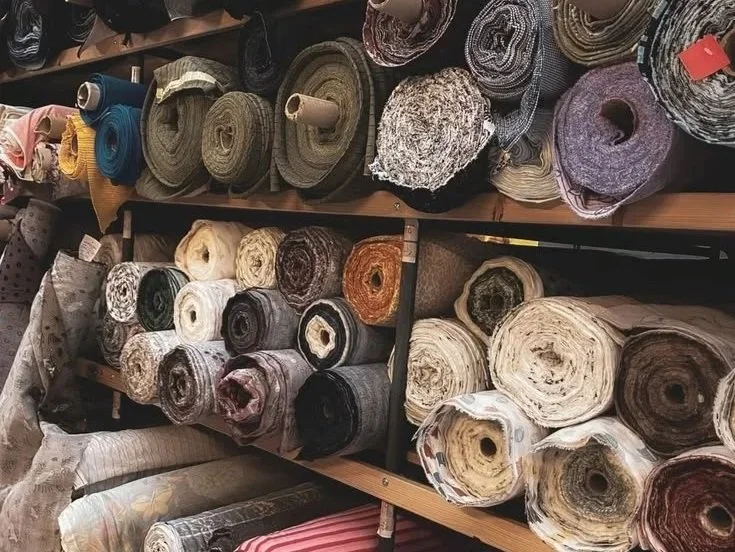
There's a particular kind of Irish inheritance that has nothing to do with land or jewellery. It's a bolt of fabric that never got cut. Just sitting in a warehouse somewhere in Mayo or Armagh or Antrim, folded and forgotten, while the factory that made it went quiet.
Foxford Woollen Mills closed its gates in 1987. Receivers walked in, the looms stopped mid weave, and for a while it looked like another mill gone for good. It reopened not long after, one of the few Irish mills from that era to survive its own closure notice. Most weren't so lucky. Ulster Weavers shed eighty jobs across two plants. Elastic Knitting at Galgorm, which made lingerie and sportswear, lost sixty five. The old Courtaulds plant in Lurgan, which had been turning out fabric for M&S leisurewear, closed with a hundred and forty jobs gone and nobody quite agreeing on who was to blame.
Retail had changed, apparently.
What nobody talks about is what happens to the fabric when a factory shuts. It doesn't disappear with the jobs. It sits. Finished cloth, dyed and woven and ready, with no garment left to become. Some of it gets sold off cheap to clear the books. Some of it goes to landfill because storage costs more than the material is worth. And some of it, the lucky rolls, end up in the hands of a designer who knows what they're looking at.
This is deadstock. Not offcuts, not scraps, but full runs of fabric that were made properly, for a purpose, and then simply never used. A handful of Irish designers have started going back for it deliberately. Niamh Mannion, who trained at NCAD in Dublin before moving through Copenhagen and London, builds embroidered textile collections out of deadstock and vintage material, drawing on Irish folklore and neolithic carving for the imagery she stitches into it. The fabric isn't a blank surface for her. It already has a history before she touches it, and the work is partly about not erasing that.
There's something genuinely moving about that approach, and it's worth being precise about why. An heirloom is traditionally something that survives because someone decided it was worth keeping, past its obvious usefulness. Think, a ring that nobody wears anymore but can’t throw out either. What these designers are doing is applying that same logic to industrial cloth. Fabric that outlived the building it was made in becomes, in their hands, something closer to memory than merchandise. Cut it into a garment and you're not just recycling material. You're giving a factory that no longer exists one more chance to make something.
The word deadstock has started doing a lot of unpaid marketing work. Once a term like this becomes desirable, brands start reaching for it whether they've earned it or not. A swing tag that says deadstock sounds responsible. It sounds like someone rescued something. It doesn't require the retailer to say where the fabric actually came from, how long it sat unused, or whether it came from a shuttered factory at all. It may just be overrun from last season's production at a mill that's very much still operating. The word has enough emotional weight now that it can be borrowed without the story behind it.
That's not sustainability. That's vocabulary theft.
The difference is traceability. A designer working honestly with deadstock from a closed Irish mill can usually tell you which one. They know the yardage because there wasn't much of it to begin with, which is precisely why these garments are small batch and often expensive. There's no version of this that scales into a high street rail. If a brand is offering deadstock in unlimited quantities at a familiar price point, something in that sentence isn't true.
None of this is really about fashion in the end. It's about what a country does with the physical evidence of an industry it let go. Ireland's textile sector didn't collapse dramatically, it eroded, plant by plant, through the closures of the 80s, 90s and 2000s, mostly for reasons that had nothing to do with the quality of what was being made. The cloth left behind is one of the only things that can still speak to that, because the buildings get sold and the machines get scrapped and the workers move on to other jobs. But the fabric, if someone keeps it, waits.
Cutting it into something new isn't nostalgia. It's closer to a refusal. A refusal to let the last thing a factory made be the closure notice.
Written By: Pranamya Shetty
Edited By: Hazel Hunter
