An interview with Olivia McLaughlin: Director of DIFF’s Discovery Award-winning Short: Parting.
It was a pleasure chatting with Olivia McLaughlin – an Irish writer, producer and director of music videos, commercials and films based between London and Dublin – about her professional debut Parting, premiering at the Oscar®-qualifying Galway Film Fleadh, where she was nominated for the Bingham Ray New Talent Award. Parting then went on to screen at BAFTA-qualifying and DIFF, where it received a Discovery Award in association with Screen Ireland. The film has since won a Silver Award for Best Direction at the 2025-26 Shark Awards. We chatted about her identity as a film-maker, the story of how a film gets made and the importance of community in the Irish film industry.
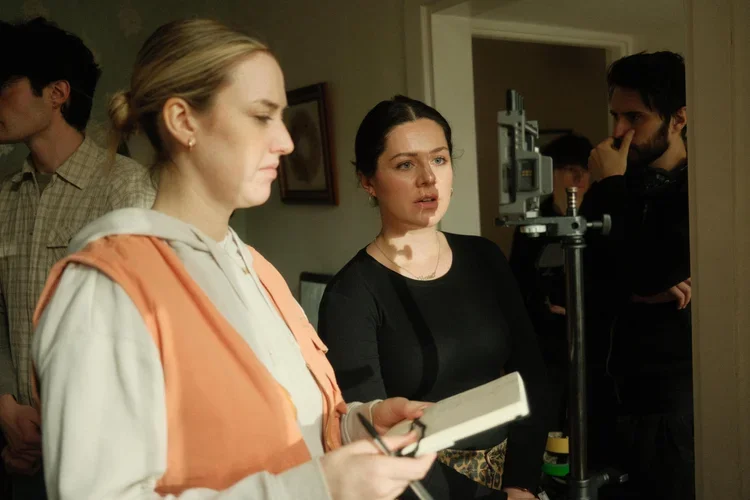
So, how would you describe your films?
Well, it was never a conscious decision, but I suppose all of my work has been people-focused so far. It took me a long time to figure out what my favourite films were and what I wanted to make. When you’re a budding film-maker, it can be hard to thread one recurring theme, but now I feel confident in stating that I want to make character studies, stories grounded in the everyday and retrospectives on the seemingly smallest moments in our lives. I’m also definitely drawn to the female lens.
My latest short Parting looks at Ireland’s mass exodus to Australia - but really it’s about what it feels like to be the one left behind. It explores that particular eldest-daughter mix of guilt and responsibility and is a reflection of where I am in my own life - navigating family, friends leaving, and figuring out how much of myself I'm supposed to prioritise in my late 20s.
Generally, my goal is to use experience to invite personal experience.
I like spaces somewhere between drama and comedy.
Do you think the drama creates comedy in itself? Or are you writing serious dramas and then inserting some comedy yourself for emotional relief, ha-ha?
Honestly, I think they come hand-in-hand. You can’t have the good without the bad. Life is inherently funny, even in its low moments. There’s so much humour in heartbreak, for instance. I think drama and comedy is just an apt reflection of everyday life.
And Parting is a great reflection of this style. Walk us through your process of writing the short.
Well, Parting is ultimately a film about how we choose to express love in our family dynamics, told through the lens of emigration. I became really interested in sibling relationships and that’s where my thematic goal found its framing.
So I sat with it and let the thoughts swirl around, and it must have been nine months before I even put anything on paper.
Personally, I had a friend who moved to Australia, and I just found the process of saying goodbye confronting in a way which I was not expecting, coming to terms with the weight of a time-zone where it was near impossible to keep up.
So I connected my personal experience to the sibling relationship. I wanted to look at that moment of finality, where a sense of childhood ends in some way.
So I wrote the script, did the redrafts and then applied for two short-film funding schemes and… didn’t get either of them.
And that set me back; I didn’t know where to go from there.
However, I’m happy it didn’t get funded back then because it gave me time to look over the script and get notes, one of them being to reconsider the perspective.
Instead of making the sister who leaves the main character, I shifted the perspective to the one who is left behind – that way, I could bring the most truth from my own personal experience.
Then I just had the moment where I said: I’m just going to make this myself.
I could be forever waiting for the funded money, so I relied on the industry friends I’d made since 2019 and some saved-up money that y’know, didn’t need to go to a car or anything like that, ha-ha. Pre-production was done in three weeks. Editing was done in three weeks. It was all now or never, and luckily worked out for the best.
Was a sense of community in the Irish industry important to you then?
Yeah, I think that the film industry (all media, commercials, music videos, etc.) attracts collaborative and kind people, who are very open and willing to help each other. There’s this unspoken code and language. You get the sense that people really are in it for the work. It's a wonderful community. And I have made some of my best friends in it, and everyone just wants to make good work and see their friends do well. I remember my lecturer from film and broadcasting at DIT (now TU Dublin) said that the main thing that will get you jobs is being sound…above anything else!
And now I see she's completely right. I’ve been completely bowled over by the generosity shown to me.
And how was it to experience the Dublin International Film Festival (DIFF) ?
DIFF was great, speaking of community, Diff were so fantastic at creating a sense of community and supporting and platforming their filmmakers.
Their communication was so fantastic and so clear in the lead-up, which is always really appreciated. They curated a beautiful program of work, and I was able to connect with some really exciting, like exciting other filmmakers from other countries. Many festivals curate Irish and international shorts separately, but with Diff, international and Irish shorts were programmed together, which was great because it gave such a diversity of work and gave audiences the opportunity to watch films they may not be exposed to otherwise.
And of course, it was truly an honour to win the DIFF discovery award. It just means the world to have something say: yeah, keep going. Being a director, there’s not any set path; every single person’s journey is different; there’s no litmus test. So, getting that award is such an amazing signpost that…maybe you’re going in the right direction.
So, how do you define yourself as a filmmaker now and going forward?
The one thing I want to do is just make people feel seen and heard when they watch the work. I think that's a film’s greatest strength, to feel and see ourselves in different characters.
I feel passionate about telling stories about Irish women and being there for my actors, too. For example, I took acting classes for Parting to better understand their perspectives during the shoot.
I think generally we’re still catching up on diversity in the mainstream on screen, and to create inherently Irish films about girlhood and womanhood that could connect universally… that’s the goal –
and of course, to try to make some people laugh!
Written by: Ben Lynch (ben_lynch__)
Edited by: Shaunamay Martin Bohan @f4wnfatale
