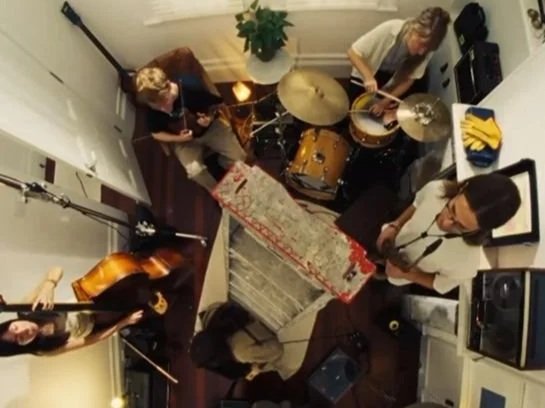
One of the best gigs of last year had no stage and no door staff, and it smelled of damp carpet and Lynx. It was a Tuesday, in an industrial unit behind a tyre place, and the only people playing were playing for themselves. Anyone early for a friend's practice got forty minutes on the corridor sofa, listening to a stranger's drummer work on the same fill through two walls. He got it on the eleventh attempt. Someone further down the hall shouted ‘YES’ at the exact moment it landed.
Headliners have received a smaller reaction.
Everyone writes about venues. Closures get petitions, hashtags and a sad photograph of the sticky floor. Nobody writes about the rehearsal room, which is odd, because the rehearsal room is where the band exists. A venue is where you get judged. The room is where you are allowed to be bad for ninety minutes at a time, and that is the most valuable service.
The economics are strange and wonderful. A room in Dublin costs somewhere around a tenner an hour, give or take, and split four ways that is less than a pint each. For that you get a box with no windows, a house kit with one cracked crash cymbal everybody has learned to avoid, and a bass amp that hums a note nobody has ever identified. By the second song it is twenty-eight degrees in there. By the fourth, someone has taken their jumper off and is holding it in their teeth.
The soundproofing is a running joke. Egg boxes do nothing, and every band knows this, and the egg boxes stay up anyway, like a religion. The real work is done by carpet tiles, a mattress someone's mom donated, and the sheer thickness of a concrete unit built to store pallets. What leaks through is a muffled war between six genres at once. Walk the corridor on a Thursday night and you will hear a wedding cover band, a teenage hardcore outfit and something that sounds like a man arguing with a modem, and all of them are working very seriously.
The corridor is the point, actually, every good rehearsal complex has one:
a narrow stretch of lino with a kettle, a fridge containing somebody's yoghurt from March, and one sofa that has seen things. Rooms are booked back to back, so one band is always dragging gear out while the next drags theirs in, and in that five-minute overlap more music business gets done than in most industry panels. Leads get lent. A snare stand changes hands. Someone says, "you should come down to ours, we've a gig in Cork" with the reply of, "we'll need a lift" and a support slot is born, long before any promoter has heard of either party.
The noticeboard does a quieter job. It is always the same:
a cork square gone soft with drawing pins, layered with small ads whose tear-off number strips have mostly been torn off.
‘Bassist wanted. Must like Slint. No Ed Sheeran.’
That one had two strips left out of ten, which tells you either that Slint fans are scarce or that the bar for liking Slint is higher than the ad let on. The best is the drummer who lists his influences as ‘everything’. The impulse is understandable. It is also the single least useful sentence in the history of recruitment, and nobody rang him.
But nobody finds their band through a noticeboard now, people say, it's all Instagram. Try telling that to the keyboard player who answered a handwritten ad in 2019 and is still in the band. You can lurk online for years. A noticeboard asks you to ring a stranger, which is how you find out within ninety seconds whether you can stand each other.
The sound deserves some honesty, since it's rarely discussed. Most songs arrive by accident. Somebody retunes between numbers, hits a chord by accident, and the other three stop dead. "Do that again." Nobody remembers what they did, so the guitarist plays eight wrong things until the right one reappears. Then comes the ritual of recording it on a phone propped against a speaker, and the file that results sounds like a hoover being thrown down a stairwell. Plenty of the best Irish records started life as one of those files.
The band still has it. They will play it to you if you ask, and you should ask.
There is a social hierarchy too, and it has nothing to do with talent. The most powerful person in any Irish band is whoever owns a van, or a mother with a Hiace and a good nature. Next comes the person who has a key. Drummers who rely on the house kit are the freest people alive, turning up with a pair of sticks and the smug air of a man travelling hand luggage only. Bassists are made to carry everything and are never thanked. Somebody should thank them.
And then the rooms close, and there are no petitions. This is the part that should make people angry. When a venue shuts, the arts pages notice. When a rehearsal complex sells to a developer, a notice goes up on its Facebook page, six bands share it, and by the following month there are apartments where the corridor was. Councils and funding bodies love to talk about ‘live music infrastructure’, and in practice they mean a stage with a licence. Meanwhile the thing that feeds that stage, the ninety-minute, tenner-an-hour, four-bands-a-night churn of the humble room, gets treated as a commercial landlord problem.
It isn't. If you want gigs in ten years, fund the rooms. A venue with nobody to book is a bar with a PA.
Outside Dublin it is worse and also better. A band in a rural county might drive an hour to reach the nearest proper room, so each session becomes an expedition with sandwiches, and the economics push everyone into sheds and garages. Garage bands are real, and so is the damp. A drummer in the west keeps his snare in a bin bag in the boot because the shed sweats. The music that comes out of those places has a particular tightness, the sound of people who had to earn the hour.
The lad from Room 4, by the way, was gone by the time anyone looked up. His slot ended, the door opened, and four teenagers carried their stuff past the sofa, leaving behind a faint smell of hot cables. Nobody on that sofa ever found out his name or his band. They would know the fill anywhere.
Written By: Pranamya Shetty
Edited By: Hazel Hunter
