The Claddagh Ring and the Test of Time
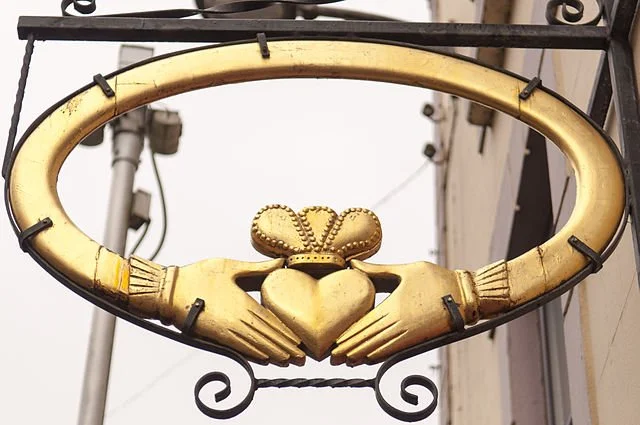
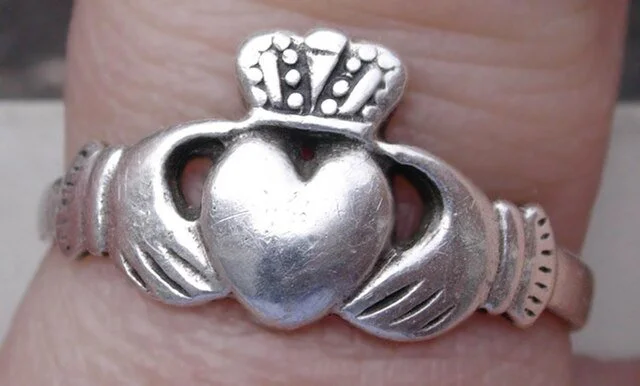
If you’re walking down the street and see the iconic Claddagh ring, you know they’re Irish or have some connection to Ireland in one way or another. But what makes this symbol such a statement piece for the Irish? Well, it’s not just a simple wedding or promise ring; it’s so much more than that. An intentional and symbolic piece, featuring hands joining to hold a crowned heart at the centre of the ring. The hands symbolising friendship, the heart symbolising love, and the crown symbolising loyalty, we have Galway native Richard Joyce to thank for these 3 pillars.
Richard Joyce, who was intent on leaving Ireland for the West Indies, was stopped by Algerian pirates. After enslaving the crew of Joyce’s ship, he became a slave to a man in Algiers, where he trained as a goldsmith. King William III of England in 1689, then demanded that all his subjects be released (the very few things to thank the English for), and Joyce returned to Galway, where he created this iconic symbol of the Irish. With Joyce’s pieces on display from 1737, you can see early works of the Claddagh ring in the (you guessed it!) Claddagh Ring Museum in Galway.
We’ve seen this symbol on the big screen, in small towns, on the streets of Dublin, and even in international settings. So what has drawn this ring from its original intention of romance to now a statement piece of Irish heritage?
While originally it was intended to be passed down from families, usually a mother to a daughter as a ‘coming of age gift’, think of it as the Irish symbol of debut. It was used as a form of communication, where the placement and way you wear it tells all. If you wear it on the right hand with the heart facing outwards, it says you’re single (tip: delete your dating app and buy a claddagh ring). However, if you wear it on the right hand with the heart facing inwards, you’re spoken for but not married. Now, getting to the left hand, if you wear it with the heart facing outwards, it signals you’re engaged. And finally, if you wear it on the left hand with the heart turned inwards, you'd better start living by the happy wife, happy life.
But the popularity of the Claddagh ring doesn’t come from its conventions; it comes from the Irish identity it expresses. Not only is it a beautiful and unique design, but for the Irish, who have a long and heavy history with immigration, this ring is a way to carry their roots with them to any part of the world. So it’s no surprise that the Claddagh ring has become so popular internationally in the United States and Australia, places where you’re sure to find communities of Irish immigrants.
And these pillars are exactly what you find in the Irish gene, regardless of Irish communities internationally or on their native land. Friendship, love, and loyalty are what keep your ears open for Irish accents anytime you're abroad. While the running joke is that you find Irish people everywhere, and usually more than one, their sense of friendship and loyalty is one of their biggest strengths. For people who have had their identity swayed this and that way, there’s no doubt that community is what keeps these traditions going.
So passing down a Claddagh ring to your daughter has less to do with finding her a husband and more to do with being loud and proud about her Irish identity. And we not only see this shift of design through families, but also socially. Where the Claddagh ring has become a punchline for flirting. With openers such as ‘turn my Claddagh ring upside down’, the iconic ring has become a cheeky way of flirting among the Irish.
While the strict conventions of the ring have lightened up in recent generations, with many buying them for friends, or wearing them the untraditional way on whichever finger they like. While Queen Victoria made it desirable among all classes, the Irish deserve credit for keeping the culture alive. From keeping it as an heirloom within many Irish households to gifting it among friends, this ring doesn’t seem to be going anywhere.
And with the coming generations, the ring has evolved with recent fashion, and these rings are now almost entirely customisable. From mixed metals, all gold, all silver, stone in the heart, the sky’s the limit. This tradition has also found its way into trends, where you can find inspiration for stacking your Claddagh ring with other rings. Naturally, the new Irish generation has taken pride in this tradition, as it is not a sign of societal oppression, which dulls one’s identity and defines them simply as a marriageable or non-marriageable woman for men. It is a symbol of individuality that meets history. Where the man pursues the woman based on those three pillars. It is a form of strength for the woman, where, if a man wishes to turn her heart the other way, he must be able to provide her not just love but also friendship and loyalty.
So, with this ring found in shops all over Ireland, people come to Galway from all over to purchase the iconic symbol of love and resilience. For Joyce, love could only endure through loyalty and friendship. And with legends saying Joyce returned and designed the ring for his love, there seems to be no test of time that love can not pass, as these rings continue to grow the Irish community, whether at home or away.
Written By: Sophia Arceo, @sophiearceo
Edited by: Shaunamay Martin Bohan @F4wnFatale
