The Tale of the Tarot
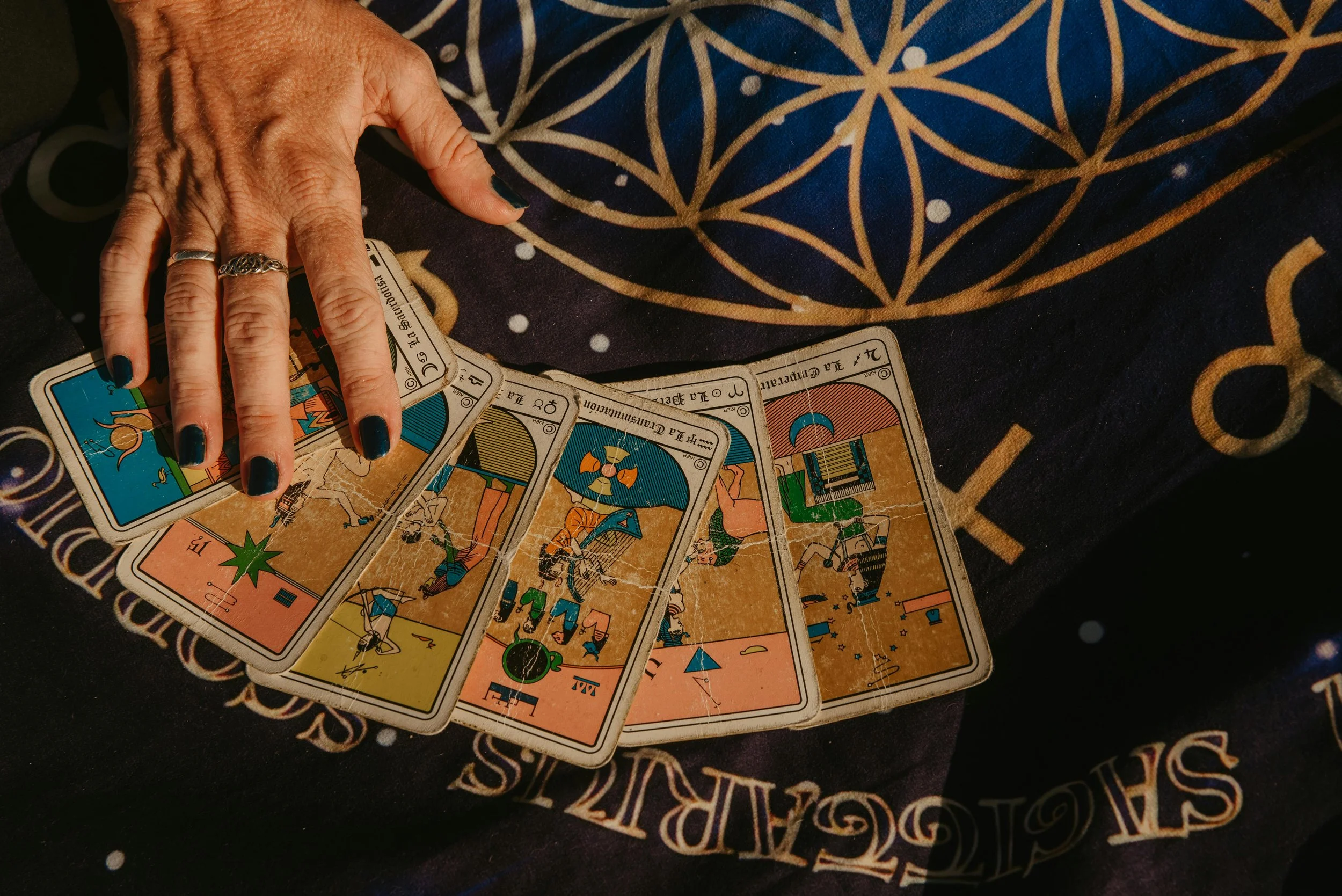
I think we could all use a good tarot card reading: from the lottery to the model-level barista at our local coffee shops, a little nudge in the right direction would be nice! Well, you might want to call up the local fortune teller instead, because that’s not exactly how tarot card readings work as it is an often misunderstood practice.
First, let’s start with the basics. A deck of tarot cards consists of 78 cards, of which 22 triumph cards (or ‘Major Arcana’) and 56 pip cards (or ‘Minor Arcana’). Noted for their intricate and whimsical designs, the Major Arcana are decorated with archetypal figures such as the Emperor, the Devil, and the Fool – along with astrological elements such as the Sun, Moon, and Star, and of course, some more important symbols known as Strength, the Tower, and Death, as VAM UK explains in their ‘a history of tarot cards' section. These symbols are just as historic and cultural as the more widely used French suits of spades, clubs, hearts and diamonds; instead, these lesser known decks display the Italian suits of swords, cups, coins, and batons or wands (punished for their beauty?).
It is a no-brainer that as a practice of the soul, tarot uses the Italian suit decks. The intricate designs of the tarot cards are not just for show: they are 'to represent aspects of life or the four elements - swords (thoughts or air), cups (emotions or water), coins/pentacles (material aspects or earth), and batons/wands (actions or fire),' VAM continues. And with their history, their meaning over time has changed, from rumoured to be associated with classes of society, signaling that everything has an order and a place, one comes before another and one comes after the other.
So if in the Italian suit, did they originate in Italy?
Not really. Like most practices today, they have passed and evolved through many names and places alike. While there is no one answer to this, there has been evidence leading historians to all parts of the eastern world: from India, Egypt, China and Korea, the concept of the reading of the soul in the early 12th century was central to all these civilisations and many others. Only later, in the 15th century, we see tarot enter European cultures, geographically exported through Italian ports at the bottom edge of the continent. And despite the hierarchical themes of the cards, it was thanks to the merchants, traders, and seafarers that this practice was spread across continents and seas.
The Victoria & Albert Museum houses the oldest surviving tarot cards from the 15th century: it is described as a rare, gilded, hand-painted Italian deck of tarot cards. I guess boredom is the greatest portal to one’s creativity, since it was the boredom of the working class that led them to hand-paint these cards in an attempt to pass the time on long voyages. As their popularity grew among the working class, they trickled their way up to the nobility. Many of the Italian Renaissance courts may not need a tarot reading to tell them they were in luck; however, they used a 'trick or trump game, in which higher cards beat lower cards' that would often be more personalised and recognisable through mythological themes and individualised aristocratic insignia. And every artistic display on these cards were more intentional than one might think. The Major Arcana coincided with the Renaissance carnival processions, and are undeniably representations of performers and an idealised Italian society.
But what’s the point of a game if there’s no prize?
The late 18th century decided to rectify the situation. These cards turned to rewarding its users with a fortune. Once Jean-Baptiste Alliette, known in the cartomancy world as Etteilla, created the first divine-driven deck of cards, providing the cards with a value beyond currency. He quickly switched from the standard French suited deck to the Egyptian associated tarot cards (unproven today) once he heard news of the magical origin.
In the 19th century, the tarot became an extension of the Bible, going hand in hand in the world of divination. In 1861, Alphonse Louis Constant, known in the occultist world as Eliphas Levi, was the author of the book ‘Dogma Et Rituel de la Haute Magie’and the defining the terms ‘Major’ and ‘Minor Arcana’, legitimising tarot cards as a true telling of the divine. The effectiveness of this practice gives credit to the unique blend of direction by the unknown. This practice was ‘changed to fit with a combination of beliefs from different religions and mythologies from numerology and Kabbalah’. This practice was not held back by traditional rules or strict codes, and it didn’t speak to a Christian or Muslim; rather, it referred to souls, which we all possess no matter the background.
What more divine legitimisation than having Arthur Edward Waite bring an English translation to Britain in 1886? He was no King James, but it did lead to the Hermetic Order of the Golden Dawn. It was a religious community in itself, with a focus on occult and ceremonial magic with tarot cards at its core. What’s more divinely fated is that Arthur Edward Waite and Pamela Colman Smith created the tarot cards we know and love today: known as the Ride Waite Smith tarot deck, it has that undeniable Colman Smith design on the artwork brought to life in 1909.
This was no ordinary design or creation of the tarot cards: it was the transforming of the practice of tarot reading to the intuitive soul-pulling readings that are so easily accessible. No complicated or strict rules apply: it is more fluid and emotionally driven through Colman Smith’s artistic vision.
Written By: Sophia Arceo, @sophiearceo
Edited By: Kirsten Baldwin, @teddys_bookshelf
