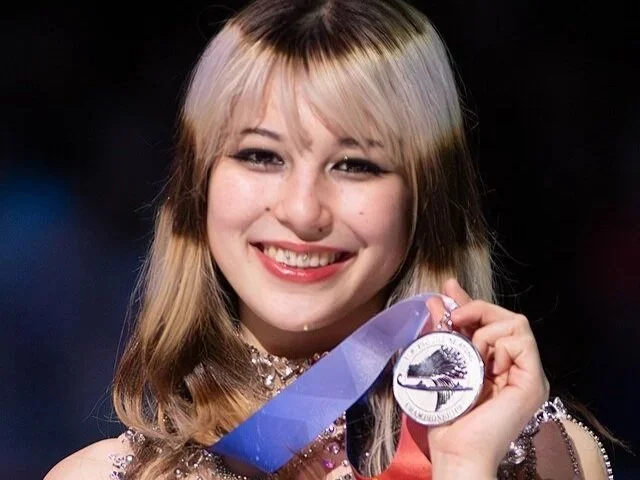
Let’s say you have been playing a sport since you were five years old and then you go on to complete the highest level of said sport at just sixteen years old. Your formative years will naturally be spent morphing yourself into a product of that sport. For some with such immense talent, can bring on high levels of stress which trickles down into parental relationships. Parents can become obsessed with bringing their children to their full potential, at whatever cost.
Alysa Liu has proven the difference between talent and passion with her comeback at the 2026 Olympic Games. Becoming the first U.S woman to win a world title since 2006. And she hasn’t stopped there; she is now the first American woman to win an individual medal since 2006 and is the first American gold medalist since 2002.
Most would have thought her career was over in 2025, when she not only came back 4 years later, but made history with her medals at the Olympics. What more could an athlete work towards? Well, if we are talking about ‘work’, it is exactly what Alysa retired from. From the age of five, once her potential was obvious, she was no longer viewed as a kid but viewed as a tool for success.
And many child athletes can relate to this feeling of performance, required in so many of these sports. For figure skating, a sport that relies heavily on appearance, can easily become a toxic space. You have to look the part as well as play it, Alysa became less like a child and more like a robot. She skated everyday under a grueling schedule and was told what to wear, what to eat, and what music to dance to.
In the most formative years of her life, Alysa was essentially ‘built’ for figure skating. And while externally it gained her praise and recognition, there was a clear disconnect from her identity she was never allowed to explore. And while she was able to perform well, as her medals show, her presence was never there, rather the presence of her father’s expectations was.
As any job goes, there becomes a transaction of you ‘owe’ this result to match the money and investment the parent puts out. As Alysa’s dad, Arthur Liu, who takes credit for “bringing [Alysa] up to two national titles” in a 60 minute interview. He is right that he, himself, brought about those titles as Alysa made clear “it was basically [her father’s] business, [and] wasn’t really [hers]” in the same interview.
To the world, she has won those titles, and yes her talent has done all the heavy lifting. But the drive came from her father and others, and those wins were in turn for them. She was simply a tool to reach for medals, and once she won ‘enough’ medals for the expectations of others, she reached the time to retire.
Even now, she is not coming ‘out of retirement’, because she is coming back on her terms. Making sure she is simply “adding skating into [her] life” as “skating isn’t [her] life” she makes clear in an interview with Players; Tribune. And many of her recent interviews have included Alysa talking about her program and her taste and her terms, that it’s almost like Alysa is skating for the first time in her life.
The best part about doing something out of passion, is that there is no ceiling. There is no ‘enough’ when you are the one reaching for the immeasurable joy of the game. When Alysa thought that there was no passion in something she saw as a ‘job’, stepping away allowed her “to learn detachment” questioning if “she did really hate skating” and dissecting the parts she loved and didn’t love.
Not only did her coaches notice a difference in her skating since coming back, but there is an enchanting way she moves that the audience can feel. Before even finishing her performance at the ISU World Figure Skating Championship, she received a standing ovation before the music even stopped. And this wasn’t just the admiration of the sport but the passion and deliverance of the performance that Alysa describes as just wanting to make people “feel some strong emotion”.
So they’re right to say passion beats talent, because only when Alysa began to figure skate for herself did she actually start to connect with the crowd and communicate her creativity. Many may think when it comes to performance-focused sports that you have to choose between creativity or the judges, but instead Alysa is showing us that it’s a relationship between the audience and yourself, which is most rewarding.
And you may be thinking it’s naive to de-center sports from winning, but the danger comes from the toxicity of valuing winning and nothing else. Where so many children like Alysa, were taught that winning was the only point of the sport. And external opinions begin to consume them, whether it be critics during their career or athletes coming out of retirement. As Alysa proves, if the sport is bringing you joy, then how could you not be winning?
Alysa Liu has inspired so many young athletes to not become a copy of what a winner ‘looks’ like, but make their individuality a part of defining a winner. And just as we are constantly evolving and growing, it’s important not to suppress creativity and let it come and go in waves. Whether it takes four years, like it took Alysa, or a month to detach from external identities and find the reason you have a passion for the sports you’re involved in.
Written By: Sophia Arceo, @sophiearceo
Edited By: Alex Kelleher @alex_kelleher_
