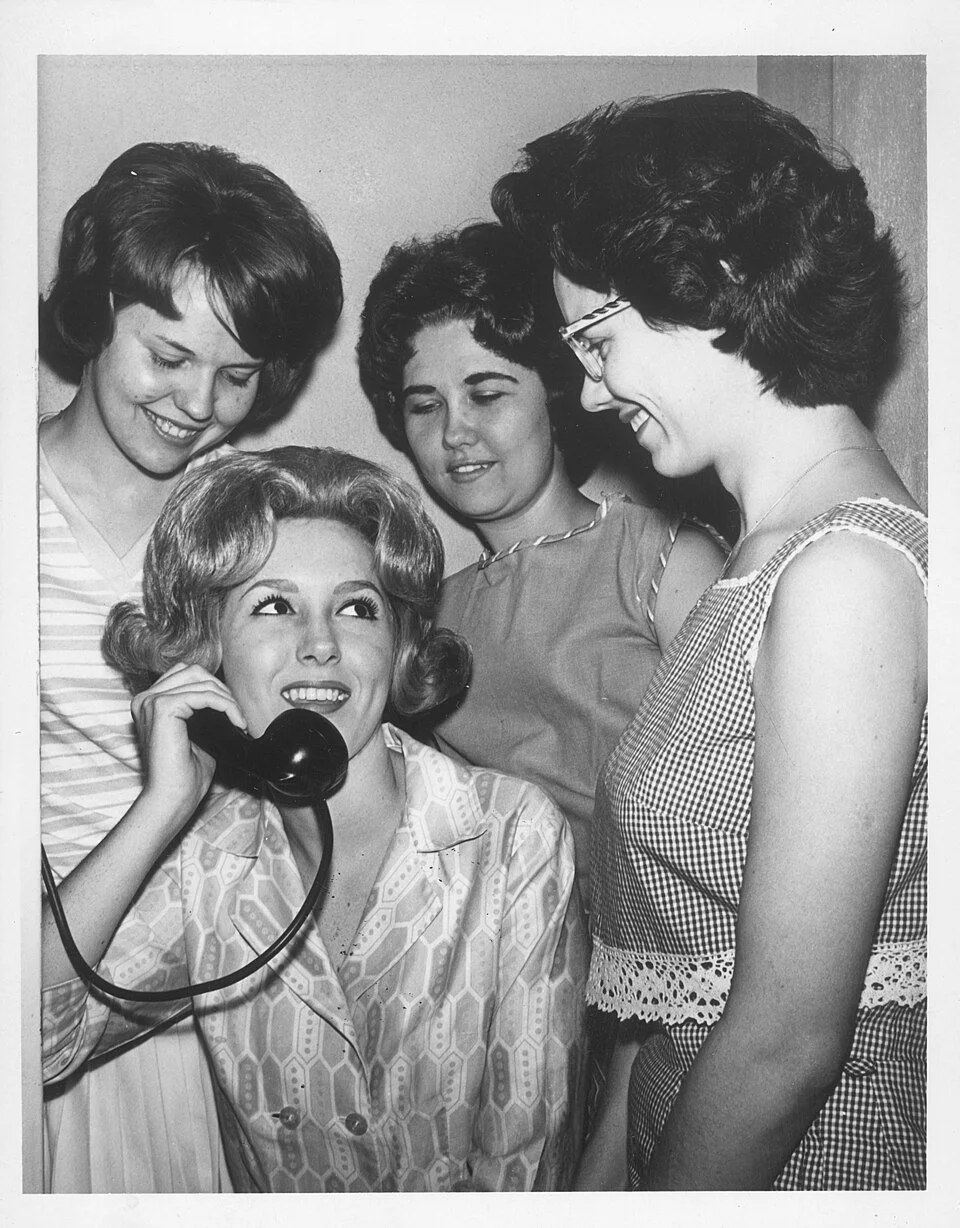
These days, we can’t tell what makes our stomachs drop faster: the same alarm we’ve had since we’ve bought our phone or the ominous calls we get every so often signaling our fight or flight. While both are seemingly nails on a chalkboard, the prior is more dreaded responsibility and the later is fear of responsibility. So do you pretend to not hear the call or do you answer and immediately ask ‘is everything ok?’ are the one of two ways a phone call is approached.
But why are we so afraid of socialising in an ‘uncontrolled’ setting? We seem to prefer the all too used to that allows us to see the message before the other person knows we’ve seen it. Giving us time to assess how willing we are to respond and to what extent does it benefit us? How did we go from going to the neighbours house and knocking on their door and asking them face to face for a favour to now waiting 5-business days to see if a friend is still a ‘friend’.
From watching early 2000s movies that showed cheeky calls able to spark romance between two people, who could hardly wait to get on the landline, and every minute used up was worth it to be able to hear the voices of those in their lives.
Phone calls served as the iconic and most powerful symbol of community, where the minute a character’s community needed to be re-defined, there was no hesitation from the main character to end the call and throw their phone in the conveniently located bin just an arms reach away. The power in being able to give or take away one's ability to call you, seen as a privilege granted to one’s community. And where would we be in today’s age and day without the testing four-way call in Mean Girls that warranted survival, effort, and skill?
Or how we will forever cherish every second of that last voicemail we receive from a loved one. We may not have gotten that on-screen confirmation, but we know that Marianne replayed that love confession from Connell again and again (and again). Phone calls were something welcomed and a liberation to strengthen the community, a sign of connecting with people from afar. The key part about phone calls that were so revolutionary was the fact that it was ‘fixing’ the problem of separation, the whole idea was trying to be as close to someone as physically as possible.
Why is our goal now to be as separated and inconvenienced as possible? Do we really want a community, or do we feel entitled to having a community at our disposal at any time? It seems that nowadays community is held on not by a thread but worse: a piece of technology. The only way this community has survived has been by switching its foundation from a village to a transactional business. From treating voice to voice communication as a gift and privilege to now treating it as a tool to control communication between their community.
Are we meant to be able to half-swipe a conversation or even know what a member of our community needs us for and determine if they deserve a response? And don’t get us started on the whole concept of leaving someone ‘on read’ that has completely altered the concept of respect in communications, where technology has somehow dehumanised communication.
It had somehow normalised the idea that we don’t owe anyone anything, not even a simple response. With most people feeling they are inconveniencing people by calling them, such as the fact they might be ‘busy’. Yet, communication and community were never meant to be ‘convenient’, so we are left with an emotionally detached community, and whether it is sustainable is questionable.
Technology’s purpose was always to provide a ‘fix’ to any and every problem our communities faced. It became a way to better communication that was once limited due to hand-written letters, where senders and receivers would worry and wait without any response. The lack of response was the problem, but somehow along the way it became the solution?
Text messages are not a step backwards to hand-written mail, it's actually a step towards further separation on its own. With mail, the thought of not knowing if you’d reach the recipient in time, or the uncertainty they’d read until you receive a response, days later or weeks later, made communication sacred. Whereas, despite the immediate movement of the message within technology still excuses people for replying to messages days late, where this constant immediate access gives the impression that community is a finger’s tap away at all times, it became a chore despite the unbelievable convenience.
So, as we continue in this emotionally detached manner of communication, is text message going to sustain the community long term?
This de-evolution of communication within a community has led to access to one’s community going through various ‘pre-check’s’ before even being able to see them. Don’t we miss the days when we could just call a friend and spontaneously see if they’re around for a coffee or a bite to eat, and no worries if not, let’s pick a day right then and there.
Don’t be alarmed, you might feel the pressure of having to decide a day right then and there, but setting aside time for one’s community shouldn’t be something to fear, it should be something stimulating and rewarding. Calling in this day and age is the most efficient way to reach and see people, yet we sit in our rooms looking at a screen and wonder how we got to the point of the lonely epidemic or anxieties around the community. Have no plans today, or just miss hearing a loved one’s voice? Give them a call because you can!
Written By: Sophia Arceo
Edited By: Kirsten Baldwin
