Is Nara Smith Really That Bad, or Do We Just Hate Women?
I enjoy watching and listening to people discuss topics I don’t fully agree with. I’m a sucker for commentary videos, Substack think‑pieces, TikTok dissertations, and the occasional “here’s why this influencer is single‑handedly destroying feminism” rant. And after listening to enough of them, I thought: why not give a different perspective? Why not say the thing that seems to be the unpopular take?
Because here’s what I keep coming back to: We support women’s right to choose… until she chooses something we personally don’t like.
And nothing exposes that contradiction faster than the Internet's favorite punching bag: Nara Smith.
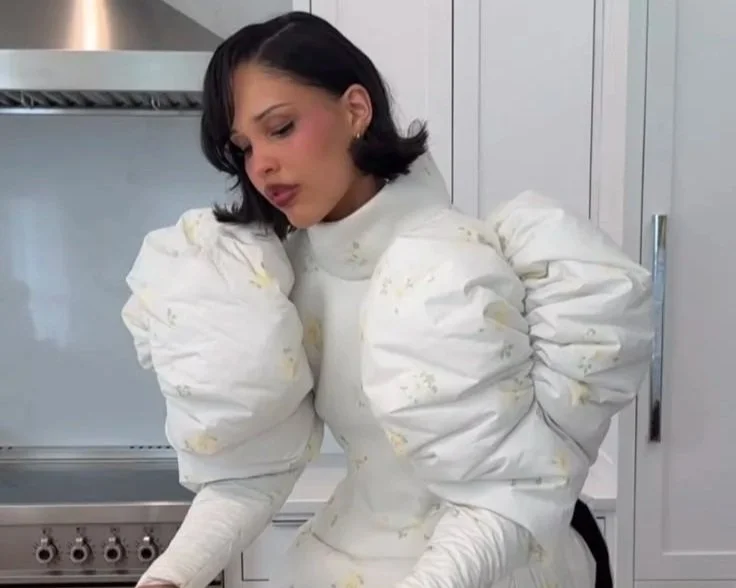
Apparently, no one cooks while wearing couture. It’s “unrealistic.” It’s “performative.” It’s “tradwife propaganda.”
Uhm… maybe you don’t, but Nara Smith does. And she’s not doing it to be relatable. She’s doing it because she likes it, because it’s her aesthetic, because it’s her business, and because she can.
But the internet hates when women can.
Let’s start with the obvious: Nara Smith is not a tradwife. She says it, her life shows it, and honestly, the math shows it too. She’s a working mom who travels constantly, shoots campaigns, writes cookbooks, runs a business, and cooks because she enjoys it, not because she’s cosplaying 1950s domesticity.
But the tradwife label sticks to her like raw dough on a marble countertop. Maybe it’s because she married young. Maybe it’s because she had kids young. Maybe it’s because she’s friends with Hannah Neeleman, the internet’s reigning queen of homesteading glamour. Or maybe it’s because the internet sees a pristine explosion of white, feather-soft flowers on a bomber jacket to cook a full family dinner and thinks: Ah yes, patriarchy.
God forbid a woman should like to cook and god forbid she should like to cook while wearing a belt as a dress, or whatever avant-garde couture she pulls from her closet that day. The kitchen is her runway and honestly, it's iconic.
But let's zoom out. Because the discourse around Nara isn’t really about cooking. It’s about what we think cooking means when a woman does it.
I’ve read the Substacks. All of them. The ones that defend her, the ones that drag her, the ones that psychoanalyze her whispery voice like it’s a Rosetta Stone of internalized patriarchy. And the critiques fall into a few predictable categories:
1. The Voice.
Apparently, her soft ASMR whisper is a patriarchal performance. A “coaxing prosody.” A fawn response. A subconscious submission ritual.
Or hear me out…maybe she didn’t want to wake her baby.
Not everything a woman does is a political statement. Sometimes a whisper is just a whisper.
2. The Cooking.
Some argue her scratch made meals are part of a high control religious aesthetic. That raw milk and sixteen hour ramen are tradwife propaganda. That her autoimmune issues are just a convenient cover for patriarchal food fetishism.
As someone who went to culinary school years ago, let me just say: developing and perfecting a recipe is one of my favorite pastimes. Cooking is joy. Cooking is creativity. Cooking is therapy. Cooking is art. And if she was a man, they’d call her a chef.
I can already hear the comments:
“OMG he’s a working dad, he cooks, he’s a content creator, he takes care of his kids AND looks good doing it!”
“Wow, he really cares about his children’s health, making everything from scratch!” But when a woman does it? Suddenly it’s oppression.
3. The Influence.
Some critics argue that tradwife influencers are dangerous because women take their content literally. They change their politics, their motherhood standards, their entire identities based on a 90 second video.
To that I say: media literacy is important. And if people were putting Tide Pods in their mouths not that long ago, maybe the issue isn’t Nara Smith, maybe it’s the internet.
Some people watch restock videos because they genuinely want to emulate that hyper organized lifestyle, the labeled containers, the color coded fridge aesthetic. And some people watch them simply because they’re soothing, mindless, and visually satisfying. Both things can be true at once. But with Nara, I honestly don’t know how many people are sprinting to buy runway Miu Miu after watching her make bone broth from scratch. Her content can be consumed the same way: calming, absurd, and aesthetically pleasing. And if someone watches her videos and thinks, “I need this exact life because she has it,” that’s not Nara’s influence, that’s a deeper issue within themselves, one that no influencer can fix.
4. The Backpedalling.
The harshest critics accuse Nara of gaslighting. Of benefiting from tradwife aesthetics and then denying it. Of performing submission while living a 50/50 marriage. Of being savvy enough to know exactly what she was doing. But here’s the thing: women are allowed to evolve. Women are allowed to change their minds. Women are allowed to reject labels that were forced onto them. Women are allowed to say, “Actually, that’s not me.” We don’t demand this level of ideological consistency from men. Ever.
And then there’s the part of the conversation that no one seems to sit with long enough: Nara’s real life.
Four kids in five years.
A surprise baby.
Postpartum anxiety was so severe she felt dissociated from her own body.
Three weeks after giving birth, she was shooting cookbook images an hour and a half away.
Deadlines. Meetings. Flights. Pumping.
And then, her child’s cancer diagnosis.
While all of this was happening, she was still making videos. Still whispering. Still plating peppermint Oreo sandwiches made from scratch. Still zipping up couture dresses and saying, “Okay, we’re doing it.”
Does any of that sound like the soft life?
Does any of that sound like a blissed out tradwife leaning on her Alpha husband?
Or does it sound like a woman girl bossing herself into the ground?
Because that’s the part the supportive Substack nailed: Nara Smith is not a tradwife. She’s a capitalist fantasy. A burnt out girlboss. A woman performing perfection while privately crumbling.
She’s not selling patriarchy. She’s selling content.
And she’s paying for it.
Maybe that’s why I relate to her. I started my own career as a young model. I moved countries after knowing my now husband for six months. I married young. I became a young mom. And by the internet’s definition, if I ever posted recipes online, I’d be labeled a tradwife too, pushing an agenda I don’t even believe in.
It’s easy for me to put myself in Nara’s shoes because I’ve lived a version of her life. And I know how quickly people flatten women into caricatures. How quickly they decide who you are based on aesthetics. How quickly they judge your choices without knowing your reality.
People can’t seem to fathom that a woman can be multifaceted. That we can change and evolve. That we can be mothers and entrepreneurs. That we can enjoy cooking and enjoy business meetings. That we can be soft and ambitious. Domestic and driven. Feminine and feminist.
Why can’t that coexist?
The answer, according to one Substack, is patriarchy.
But I’d argue the answer is also: the internet hates women who don’t perform feminism the way it wants them to.
We fought for choice.
Choice to be who we are.
Choice to do what we want.
Choice to live the life that feels right to us.
But apparently that choice does not include cooking. Or motherhood. Or softness. Or glamour. Or domesticity. Or anything that looks like ease or even hardship. You're damned if you do and damned if you don't. We’ve gone from one extreme to the other.
We hate women for choosing the “traditional route,” even when it’s obvious they’re not traditional. We hate women for enjoying the things women fought for, including the right to choose domesticity without being shamed for it.
We hate women for being women. and I would argue that it's feeding more into the patriarchy than Nara Smith feeding her kids gum from scratch.
And here’s the kicker: Nara Smith is not telling you to be like her. She’s not telling you to have four kids. She’s not telling you to cook from scratch. She’s not telling you to wear couture in the kitchen. She’s not telling you to do anything.
She’s showing you the life SHE chose, She’s showing you her fantasy, She’s showing you her art, She’s showing you her business. If you don’t like it, unfollow her. Turn off your screen. No one is forcing you to watch Nara Smith content.
But maybe, just maybe… sit with the harshness in how we make our points. Sit with the way we talk about women online. Sit with the way we weaponize feminism against the very women it was meant to liberate.
Because the truth is simple:
Nara Smith isn’t really that bad. We just hate women. And that’s the part no one wants to admit.
And to be clear, this isn’t a love letter to Nara Smith. Some of the conversations around her content are real and worth having. They matter. They deserve nuance. But what we keep doing is skipping the nuance entirely and jumping straight to the hate train, flattening every woman into a symbol instead of a person. We can critique the culture without crucifying the woman. We can talk about patriarchy without pretending every whisper, recipe, or couture dress is a manifesto. The point isn’t that Nara is perfect, it’s that our reactions to her say more about us than they do about her.
Written By: Valerin Vanegas
Edited By: Rose Curnyn
