McQueen Creative Director Seán McGirr brings pagan fuelled flare to Paris Fashion Week
Like so many creative industries today, Irish fashion designers are having a deserved moment in the spotlight. In the last two years, the industry has seen Irish designers Jonathan W. Anderson and Seán McGirr rise to the role of creative director in two of fashion’s most iconic houses, Dior and Alexander McQueen, respectively.
McGirr, 37, unveiled his Spring/Summer 2026 designs at Paris Fashion Week, marking his third collection for McQueen. Following Sarah Burton's tenure as creative director from 2010 to 2023, the decision to offer McGirr the role was met with some controversy in the fashion world. Within the industry that is frequently (and fairly) criticised for the lack of diversity regarding gender and race, many were disheartened to see a white man replace one of the very few creative directorial roles held by a woman. Alongside these criticisms, McGirr’s relative “newcomer” status was questioned, despite having worked in design roles at Uniqlo and Burberry. Most notably, McGirr led the ready-to-wear division of the Irish label JW Anderson from 2020 until his move to McQueen in December 2023. With this cocktail of mounting pressures from critics and contemporaries alike, McGirr’s first deliverance under the McQueen name had near-unattainable expectations to reach. The collection received mixed reviews, with some labelling McGirr’s choices as innovative and fresh, whilst others criticised his self-acknowledged lack of familiarity and references to McQueen’s extensive archive. However, his most recent show, which debuted his Spring/Summer 2026 collection, highlights that perhaps all artists need is a bit of time and space to get to grips with their new work, as he displays gracious reverence for some of Lee Alexander McQueen’s most celebrated designs and structured tailoring.
Showcasing at this year's Paris Fashion Week, Seán McGirr was loud in announcing that his runway looks are both a homage to and directly inspired by his favourite film, the British folkloric horror classic The Wicker Man (1973), directed by Robin Hardy and starring Christopher Lee and Edward Woodward. In video interviews found on the Alexander McQueen website, featuring the make-up, soundtrack and production teams that collaborated with McGirr to execute his cinematic vision, each of them emphasises The Wicker Man as their central reference point for the project. According to McGirr, the film not only had an unwavering impact on him from his initial introduction whilst studying at Central Saint Martins, but was also a recurring influence of his predecessor and brand creator, Lee McQueen. This fact, combined with the film’s themes of Celtic paganism and folklore that are shared in both McGirr and McQueen’s Irish and Scottish heritages, makes it a tasteful and creative choice to give the collection a referential framework that allows McGirr to remain true to the culture of the fashion behemoth he has stepped into and to his own. The Wicker Man’s influence is seen in the militant tailoring of the dark navy and blue, lapel equipped jackets, and shirts with precisely structured and cinched waists, reminiscent of the devout Christian, Sergeant Neil Howie (Edward Woodward.) The cultish pagan worshippers who inhabit the fictional Scottish island in the film are represented through billowing florals and the riotous hedonism of one of McQueen’s most recognisable trademark designs, the “bumster.” (Think low-waisted and lower it 5 inches more.) It is McGirr’s first women-only runway, another ode to McQueen, who was fascinated by women’s design, stating that ‘I want women to look stronger… I want people to be afraid of the women I dress.’ McGirr’s models look fierce, with dark, intense eye shadows and liners. Their clothes are cut with violent intention, their silhouettes are provocative and intimidating, all in line with McQueen’s ideology.
Another of McQueen’s great lines, ‘There is no better designer than nature,’ has been appropriately utilised in the pre-show promotional materials. It encompasses the central ideas of the collection and the film and designer that inspired it, which is perhaps why it is so disappointing to see AI credited in promotional shots of the incredible craftsmanship of the clothing, posted to social media. To spend so much time and dedication in the production of the pieces, it appears as nothing but an antithetical waste of artistic endeavour to have artificial intelligence lazily construct the backdrop of the photograph. Mercifully, this appears to be the only instance of the usage of AI within the show…
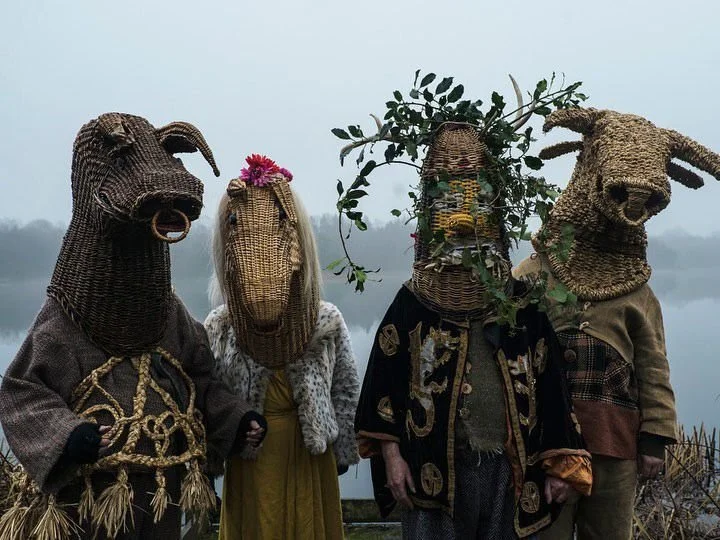
What remains so strong about this entire exhibition of fashion, and what highlights the utter futility of artificially generated work, is seen not only in the stitching of the garments but in the value of production, as Tom Scutt’s stage design and A.G. Cook’s soundtrack played a key aspect in creating the ritualistic spirit of the show. A reference to his own Irish nationality and the paganistic festivities seen celebrated in the film, McGirr also invited the Irish folk theatre and music group, The Armagh Rhymers, to perform. Donning handmade straw hats and face masks, they inhabit the centuries-old Irish traditions of mumming, storytelling and music, invoking the familiar aesthetics and imagery that The Wicker Man has become synonymous with. McGirr simultaneously executes the theme to perfection and pedestals the rich cultural heritage of his home.
Seán McGirr's most recent work displays great promise for the future of McQueen. His creative callbacks to what makes the brand so formidable are seamlessly blended with his curious investigations of the intersections between fashion, storytelling, cinema, and culture. Fingers crossed, he continues to explore these exciting avenues and pursues the unmatchable strengths of the (human) artist.
Author: Maeve Ronayne (@maeveruaneronayne)
Copyeditor : Shaunamay Martin Bohan (@F4wnfatale)
